Adult Size
Approx. 23 mm body length
Adult Legspan
Approx. 38 mm females / 44 mm males
Care Level
Easy to Moderate
Temperature Range
74–90°F
Ideal Day Temperature
75–85°F
Ideal Night Temperature
70–75°F
Diet
Live insects; some individuals may accept pre-killed prey
If you would prefer a specific gender (either female, male or random) for an unsexed/random spider, please state your preference in the "order notes" section and we will do our best to accommodate your request.
If you want a guaranteed sex, you can view our AC numbered girls and boys, which have their own individualized sections.
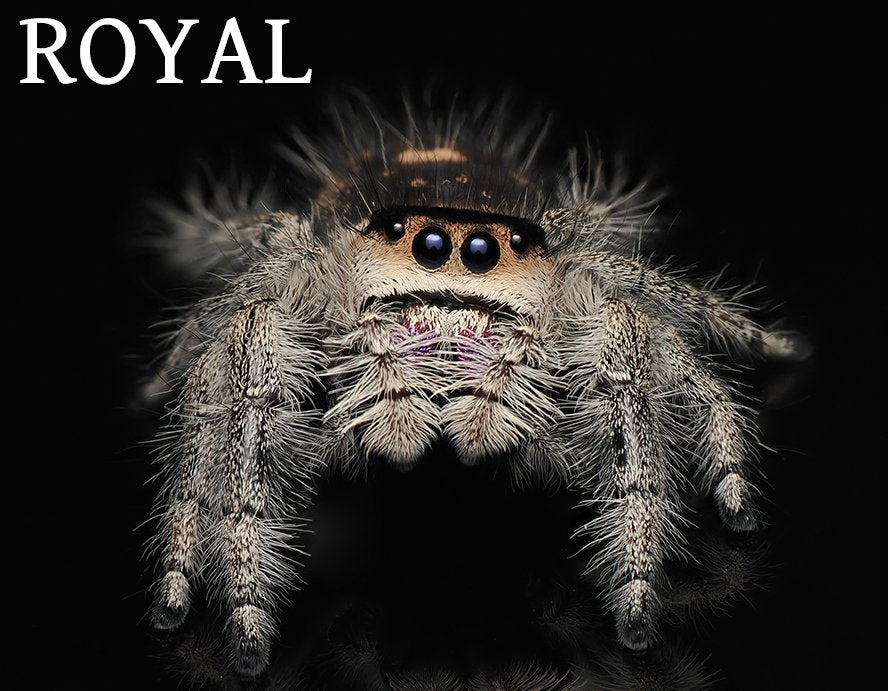
Phidippus regius, or the regal jumping spider is an absolute favorite among North American arachnophiles. It is one of the largest jumping spiders, one of the most active jumping spiders, and one of the friendliest jumping spiders kept by hobbyists. This species has been known for its royal presence and colorful varieties therefore, it is a popular choice among both novice hobbyists and expert breeders alike.
Adult males typically appear blacker than adult females, and resemble Phidippus audax. The colors of female P. regius vary significantly, such as gray, peach, orange, rufous and black, with spots, speckles and markings that are distinctively different among individuals making each one unique.
P. regius originated from the subtropics of America. As opposed to some of the drier tolerant jumping spiders and desert dwelling jumping spiders, this species prefers warmer temperatures and higher humidity. Therefore, P. regius should not be excessively wetted down, nor should it be excessively dry for long periods. Ideally, a constant humidity level of approximately 65-75% with dry substrate, along with excellent airflow and minimal condensation, is perfect for maintaining optimal health.
In terms of humidity, this species can be particularly misleading. Although P. regius originates from moist environments, they normally prefer to avoid sitting in wet conditions. The enclosure should have a feeling of high humidity, rather than being damp. There should be no standing water in the enclosure. In addition, there should be no saturated substrates, nor any excessive condensation your misting should be fully evaporated after 12-24 hours we allow maximum several hours of "dry like" conditions before remisting for optimal health and minimal mold.
Light misting in one corner of the enclosure can be used for hydration purposes. Never spray the spider directly.
Lighting is equally essential. These jumping spiders are highly intelligent, visually oriented predators, and they demonstrate the highest quality behavior in a brightly lit, warm environment with proper enclosures. P. regius will utilize the full extent of their enclosures if sufficient space exists. P. regius are active hunters, exploratory climbers, and are acutely aware of their surroundings.
As for food sources, P. regius should be fed insects that are proportional to their body size. Suitable feeder options consist of flies, crickets, roaches, mealworms and other edible items that can be utilized as feeders. A varied diet is extremely beneficial for these kings/queens. Some captive-reared jumping spiders may also consume pre-killed prey much like some captive-bred reptile species develop preferences for frozen-thawed food items to reduce feeding risks associated with live prey feeding.
P. regius must be maintained separately they are not communal.
Many captive-raised P. regius exhibit exceptional confidence, curiosity and a desire to interact with humans. Rarely if ever do they bite this is one of the more docile species if not they most docile species of jumping spiders that can tolerate gentle handling when performed properly.
Handling is entirely optional for P. regius owners however, many specimens are bold enough to exit their enclosure upon sensing human presence, inspect their surroundings and even initiate interaction with their owner without any force.
Overall, P. regius is suitable for owners capable of providing a stable temperature with moderate humidity levels for their setup. Owners who currently keep tropical plants using a grow tent or maintain additional subtropical pets will find P. regius to easily integrate into their current routine.
Male captive-raised P. regius are especially entertaining pets that command attention due to their exceptional activity level and make great pets for first time keepers.
Momma Pictures
Sunkist
https://www.instagram.com/p/DMDlSoNJauk/
https://www.instagram.com/p/DNrXg6S3gK2/
https://www.instagram.com/p/DNoh4BxSq5A/
Ursa
https://www.instagram.com/p/C_eMoVySbRU/
https://www.instagram.com/p/DFGiQZ3TK43/
Rogue
https://www.instagram.com/p/DMlkbX4BEDd/
Octavia
https://www.instagram.com/p/C95pyMhyunn/
https://www.instagram.com/p/C_OY-Qcyo6D/
https://www.instagram.com/p/C9nUDmqPO1B/
Coffee
https://www.instagram.com/p/C8YrxO4O5ph/
Emerald
https://www.instagram.com/p/C5Y6v1QvBe0